2027 Belgian Cultural Tour




and
Russellville High School and Russellville Sister Cities
are organizing the
2027 Belgium Cultural Tour,
a cultural program to go visit Enghien and Belgium during Spring Break 2027.
Russellville High School and Russellville Sister Cities are organizing a 10-day / 11-night cultural program to go visit the Collège Saint-Augustin, Enghien, and Belgium during Spring Break 2027.
What is the Collège Saint-Augustin?
The Collège Saint-Augustin is the Enghien catholic secondary school for grades 7 through 12. There are 1200 students in the school. The Collège was established 400 years ago.

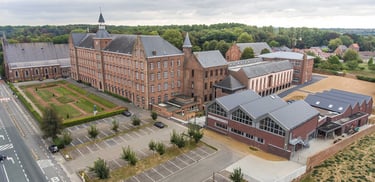
The Collège has offered to host 10 RHS students and 2 chaperones: Mrs. Barron, teacher at RHS and Mr. Van Houtte, president of the Russellville Sister Cities Foundation.
Practical Information on the Tour
The Russellville Sister Cities Foundation is currently working into creating long-lasting relationships with the city of Enghien (pronounce AW of awning + GUI of guitar + AN of antler), Belgium. The initial project is to establish Enghien and Russellville as Friendship Cities, first step before agreeing on becoming Sister Cities.
Dates
The Tour will leave on Thursday March 18, 2027, and come back on Monday March 29, 2027. The students will be excused for their absences at RHS on March 18 and 19. March 29 is a no-school day.
Stay
Each student will stay with a Belgian host family who has a child in the Collège. They will have their own room and will share most meals (all breakfasts and dinners) with the family. Lunch will be either with the family, at school, or with the whole RHS group when visiting other places in Belgium. They will “shadow” their host sibling when visiting the Collège Saint-Augustin. There will be at least one English speaker in each household.
Cost
$2300 all included.
Information Meeting
During the second half of September 2026. Exact date to be determined. For students and legal guardians.
Preparation Schedule
> Second half of September 2026: meeting with interested students and their legal guardians. Application packets distributed.
> October: reception and review of all applications; selection of candidates for oral interview; final selection of candidates; first non-refundable payment due by Oct. 30th ($500); meeting with the participants and their legal guardians.
> November: meeting with the participants and the chaperones; second payment ($800 by the 16th. The first $1300 will secure the purchase of plane tickets.)
> February 2027: allocation of Russellville Sister Cities scholarships; final payment ($1000 by the 15th)
> March: Pre-departure meeting for the participants and their legal guardians; departure on March 18; return on March 29.
2027 Belgium Cultural Tour Activities and Schedule
> 3/19: group arrival in Enghien (plane and train); welcome in host family
> 3/20: group visit of Brussels (train)
> 3/21: Sunday spent with the host family
> 3/22: visit to the Collège Saint-Augustin (transportation with host family)
> 3/23: same as 3/22
> 3/24: group visit of Enghien and the medieval castle of Beersel (train and bus)
> 3/25: visit of Brugge (train)
> 3/26: same as 3/22
> 3/27: group visit of Brussels (Atomium and Mini Europe) (train and metro)
> 3/28: Sunday spent with the host family
> 3/29: group return to Russellville (train and plane)
The Tour requires long walks and standing periods.
Who Can Apply?
Any 11th and 12th grade RHS student who has earned good academic and behavioral standings.
Enghien, Belgium
Enghien (pronounce AW of awning + GUI of guitar + AN of antler) is a a small city of 14,000 people located about 25 miles south-west of Brussels, the capital city of Belgium.

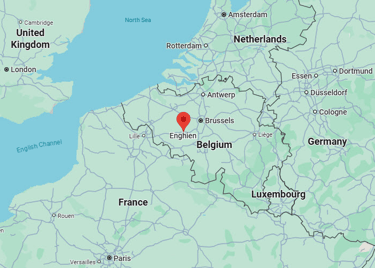
Enghien sits on the linguistic border between Flanders (North) and Wallonia (South) and many of its people speak both Flemish and French.
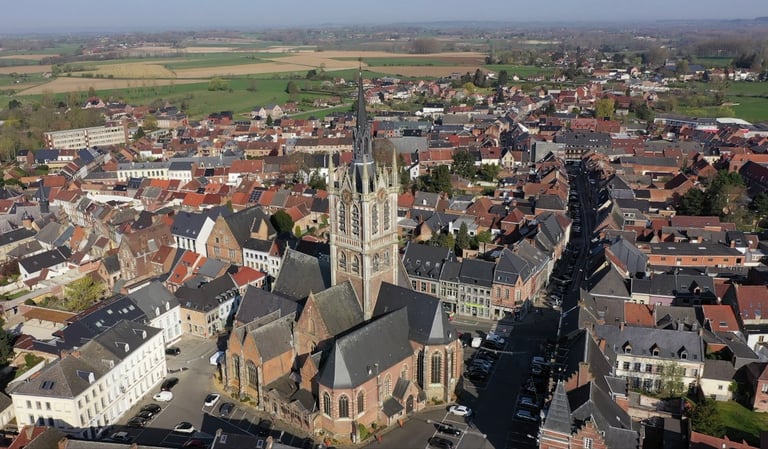
The city government publishes all its official rulings and legislation in both languages.
Enghien is the French name of the city while Edingen (pronounce ay of pay + ding + gun) is the Flemish name.
Enghien was established in the 11th century.
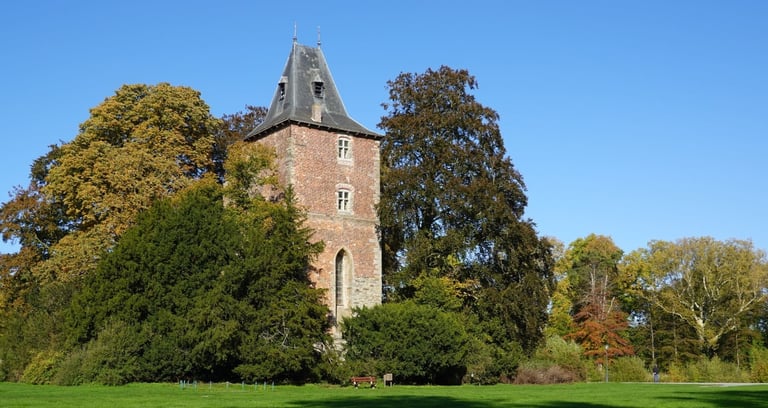
The city was built around a medieval castle, of which only one tower, that became a chapel in the late 16th century, remains today.
The medieval castle was located very near the center of town.
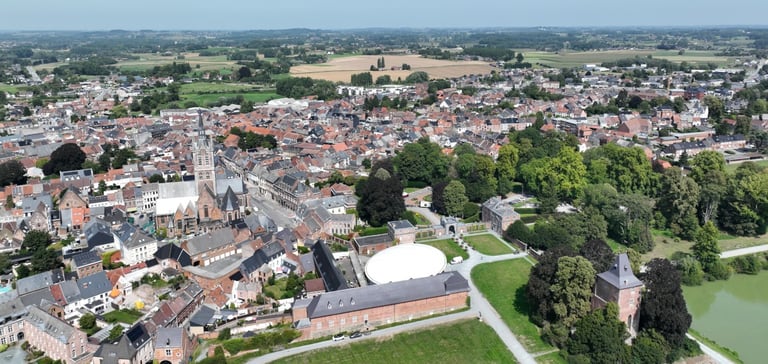
Observe the medieval tower in the lower right corner of the photograph.
This map represents the territories of Enghien and Petit-Enghien in 1775.
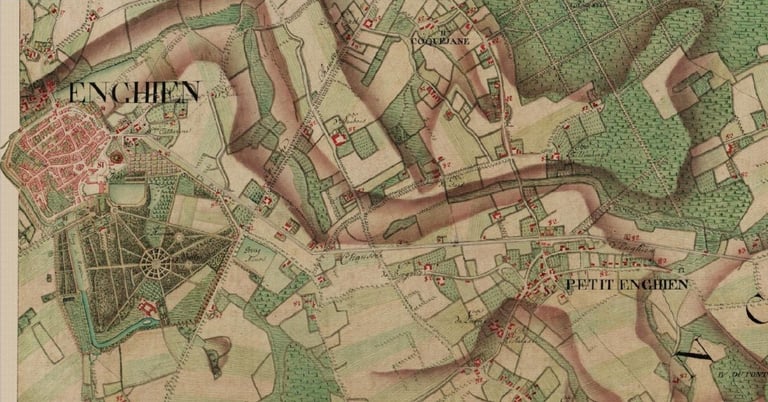
One can guess the location of the old structure the later chateau replaced, but the gardens and the park, nicely represented on the map, have kept their shapes since then.

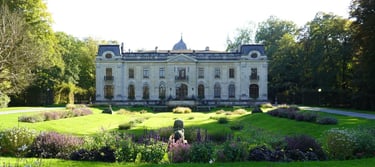
The chateau and the park are now the property of the city of Enghien.
The property containing the gardens and the park was privately purchased over 100 years ago and a new chateau was built where an old orangery previously was located.


Enghien mostly made a name for itself through its gardens and park. The original ones were created between 1630 and 1635.
André Le Nôtre visited the gardens and was inspired by them when he drew the chateau of Versailles gardens for King Louis XIV.
© 2026 Russellville Sister Cities Foundation All rights reserved